Monday, October 10, 2011
Doing the Math Part 2
USA done
74 companies or about 19 regiments
12 Color Guards
CSA done
66 companies or about 17 regiments
15 Color Guards
Okay... that's horrible! I thought I had been working at a better pace than that. In my defense I have finished oodles of drummers, more artillerymen, casualty markers, officers and... that's about it. *sigh* I do have 13 CSA & 1 USA Color Guards almost done. There are also a bunch of random models being painted... so I got THAT going for me. It's pathetic, no doubt about it.
Wednesday, October 5, 2011
Civil War Artillery Part 1
![]() |
| Artillery demo on Antietam Battlefield |
Let’s separate the kinds of artillery pieces they used and what they fired at the enemy, alright? As the war progressed the myriad of types changed and older tubes fell out of favor. In the beginning both armies used whatever they had but over time smaller caliber guns and howitzers disappeared for the most part. Since the production of all guns was time consuming and expensive to produce the Southern forces found themselves behind the eight-ball and most importantly their production and quality control in the making of fuses REALLY hurt this service for the Confederates.
Projectiles
Whether we are talking about smoothbore pieces or rifled pieces the rounds they fired were essentially the same. They might have acted differently depending upon what fired it but right now we don’t need to get into too much detail for now.
Solid shot – This is what you might expect, they were solid rounds with no bursting charge and was not hollow. Any piece classified by a weight designation refers to its solid shot weight. So for example, the 12 pound Napoleon means that the solid shot for the Napoleon weighed 12 pounds. This type of round was used to batter earthworks/buildings into rubble, fired in counter battery roles or skip along the ground vs. infantry or cavalry to mow down long lines of the enemy.
In counter battery roles the key here was to destroy the gun carriage, kill the horses pulling the limber (and gun) and disable the piece itself. Even if an opposing crew could place a shell to explode directly over an artillery crew it might be very hard to cause many casualties because of the fact that the crew was somewhat dispersed while performing their duties. This fact never dissuaded them from trying but firing solid shot was the preferred method. Strangely enough, at the battle of Gettysburg the entire amount of rounds expended by the Union army tells a very strange story regarding solid rounds. You read account after account of counter battery action and the officers write that they fired solid shot, knocking out and putting Confederate guns out of action. You read about the success the Union batteries had over their Southern counter parts yet very very few solid rounds were actually used. Why is this? Well, if you read carefully you notice that they used a high percentage of their Case shot rounds. What I think happened is the gunners used the lighter weight case shot without punching the fuses to get the longer range instead of the shorter ranch of the heavy solid round. Obviously a lighter shell flew further and performed almost as good. More bang for your buck. One additional note: howitzers did NOT fire solid shots.
![]() |
| Walcott's battery at Antietam |
At some point someone thought, ‘The gun was in the act of being loaded at the time the ball got stuck. That means that the powder charge was inside the barrel… about 2 pounds of black powder. Oh my God! There is still black powder down there and has been for the last 100 years… aiming at visitors to the State House! ‘ Ooops.
Ever skip a rock along the surface or a lake or any body of water? It skips, skims and plows its way until momentum or a very solid object stops it. This is what the gunners did with solid shot fired at infantry and cavalry. Of course it is pointless to fire it perpendicular to a single line of troops because at most it might hit two men if you are lucky. The optimum situation is when you have a line of troops wheeling across your front. The Union gunners were presented with this opportunity during Pickett’s Charge when Confederate infantry wheeled to align their attack on the clump of trees. It was a nightmare for the attacking Confederates and a wet dream for Union artillery. It was payback for what the Reb gunners inflicted upon Union infantry at Antietam.
The difference between Case shot and Shell was what was inside… or not! Shell was completely hollow and filled with just black powder. The idea was the shell would explode and send large chunks of the metal outer shell flying in all directions causing massive damage. It’s a fine idea but in practice it rarely happened like this. You couldn’t predict whether it would break into two pieces or more. Some soldiers at the time wrote home how a shell exploded right over their heads and surprisingly hurt no one! An equal amount of stories would tell of metal chunks tearing someone apart. At Gettysburg a Union brigade commander from the 2nd Corps, Col. George L. Willard, had his face torn off by a chunk of shell.
Case shot was much more predictable and deadly. As long as the fuse worked and the shot was on target it could cause horrible damage to the enemy. The round was hollow, had a powder charge but the shell was also filled with dozens of iron or lead round balls larger than a Minie Ball. Once the outer shell shattered the spray of metal was almost like a canister round fired from above, below or among. This eye witness account from Gettysburg tells the story better than I can ever explain. Union officer, Lt. Robert Carter with the 22nd Massachusetts infantry, at the battle of Gettysburg, was with the skirmish line advancing to the Peach Orchard at the end of the battle. He reported, “Our tour extended across the swale, which had been swept by the 5th and 9th Mass batteries. The scenes of that spot, as revealed its dreadful horrors to our astounded gaze, still linger on our memories. Masses of Kershaw’s and Wofford’s brigades had been swept from the muzzles of the guns, which had been loaded with spherical case, with fuses cut to one second, to explode near the muzzles. They were literally blown to atoms. Corpses strewed the ground at every step. Arms, heads, legs, and parts of dismembered bodies were scattered all about, and sticking among the rocks and against the trunks of trees, hair, brains, entrails, and shreds of human flesh still hung, a disgusting, sickening, heart-rending spectacle to our young minds. It was indeed a charnel-house, a butcher’s pen, with man as the victim.”
Canister – This was a very simple and easy to use round and probably the most effective round fired at closer ranges against attackers. It was just a tin can filled with iron balls. Once fired the can would tear apart and fill the air with the deadly missiles. It was like a giant shot gun. Not much skill was needed, just load, point and shoot. Many people assume that the range of canister was extremely short but that wasn’t the case at all. Artillery crew fired it into the air around the 300 yard mark to rain down on the heads of the enemy. Certainly firing it close up did the most damage. You could even fire two cans of canister but with only one powder charge. During Pickett's charge, a small group of about 100 Rebs broke off from the main assault at the Copse of trees and tried circling the 'rough ground' to the south. The only Union force in this area was Captain Cowan's 1st NY battery of 6 x 3 inch rifles. Seeing the Rebs rush at his guns he heard someone yell "Get the guns!" He ordered, "Double canister at 10 yards!" The six guns fired all at once. He reported that amid the smoke and flames he saw knapsacks, rifles, canteens, heads, arms, legs and chunks of flesh fly into the air. After the smoke cleared there was no one standing.
![]() |
| Cowan's battery at Gettysburg |
Saturday, September 17, 2011
Examine these photos
Here is a pic of the crew of the siege mortar, the Dictator, before Petersburg in 1864. For our purposes (painting and perhaps sculpting) it is a good thing to look very closely at the individuals in the photos. In this one, notice the Sgt. on the far right. On the outer seam of his trousers he has the wide darker blue stripe indicating him as a Sergeant. A Corporal would have a much thinner stripe. The privates have nothing. You could paint this on your miniatures if you liked but a word of caution, when issued trousers they would not come with stripes attached so a Corp. or Sgt. would have to sew them on himself. That involves work and not many bother once he was a veteran. The reason for the trouser stripes was to help identify who was an NCO when you had a Greatcoat on. Greatcoats did NOT have stripes attached to them so a stripe down the trouser leg would pick the NCO's out to others.
Also pay attention to the Forage caps (yes... not Kepis) and slouch hats worn by these Union artillerymen. The hats are different styles and colors. The same can be said for their shirts. A few here have the issue shirts and some do not. One soldier is also wearing boots and not Brogans. They also are not wearing Sack coats which is generally a social and military no-no when out-of-doors unless they are doing manual labor.
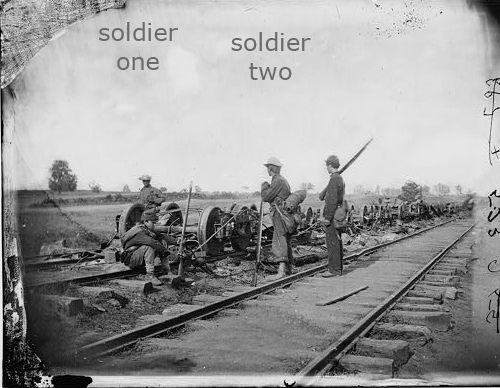
Okay here's another gem from the Manassass rail road junction. This was originally a stereo view but I clipped off the other view. Here we see Union soldiers amid the burned out rail cars. Soldier one, sitting on the tracks, has his trousers "bloused" or tucked into his socks and he's wearing a blanket roll. Soldier two has a hobo roll which I described in the 'painting Rebs' post. The last soldier on the right has no blanket roll or even a knapsack. His trousers also appear to be dark blue and not the normal sky blue color.
See what fun we can have?!
Labels:
blanket roll,
bloused trousers,
Forage cap,
Kepi,
Slouch hat
Friday, September 16, 2011
Got a question?
| Union Greatcoat |
As I have been writing and thinking about the blog, people have asked a few particular questions of me. If you have a question or two that you need answering just let me know. I’d love to help. It might be simple or complex but I’m always will to try and find an answer. It’s FUN!
Next up: on the Painting front will be artillerymen of both sides and their equipment.
Wednesday, September 14, 2011
Painting Civil War miniatures part 3
![]() |
| Lt. Gen. James Longstreet at Gettysburg |
The average Confederate soldier during the war had at times the best stuff and at other times was short of everything. As the War progressed the Confederacy just flat out ran out of money. They also had a problem getting goods from where it was made to where it was needed. Sadly some states would not share their abundance of clothing with soldiers from other states. An example is in the winter of 64-65, the Army of Northern Virginia was short of Greatcoats to keep the soldiers warm. North Carolina actually had more than they need for their soldiers and the Governor refused to send the extras he had on hand. His claim was that the Confederate Government could not force them to ship any because of their state’s rights to use as they pleased what they owned. So while North Carolina soldiers kept warm that winter soldiers from other states did not.
The average Reb was not destitute the whole time which seems to be a popular idea. The myth of the “Ragged Reb” has been debunked although some are oblivious to the facts. What is good news for painters is the fact that Rebs did use captured goods for their use. The problem is painters use this in the wrong places.
Certain items were used all the time when they could get a hold of captured goods. The most popular item was actually the common gum rubber blanket/poncho. It was a prized item for the Rebs to acquire because there was no substitute in the Confederate inventory that was so versatile and lasted. The other items were black leather goods such as; waist belt, cartridge box and sling, cap pouch, and bayonet scabbards. They would just remove the box plates, Eagle sling plate and if they could not acquire a new belt buckles they would turn the US belt plate upside down. They also used Federal knapsacks, haversacks, canteens, shoes and blankets. Using Federal clothing (coats and trousers) was a particular no-no. The Confederate armies issued orders from time to time specially stating that no soldiers should be wearing Union uniforms. Did they do it? Yes, it was done. Was it done to any real extent that you would see it in many miniatures you paint? The answer should be no unless you have a specific scenario/period in which you know. The take home message is: don’t have more than one in a hundred models.
Forage Caps and Kepis. The Forage caps and Kepis were worn but not anywhere near the frequency in which Union soldiers did. The colors for Forage caps would be just about any color within the shades of grays and browns. The bill of the cap/false shin strap was black. The strap was attached to the side of the cap with small brass buttons. The Kepi was worn but it was probably the most expensive to produce so as the war progressed fell out of use. Many gamers like to paint the Forage caps and Kepis either all blue or parts blue but this, if and when it did appear was an early war variation. Certainly blue on the Kepi was a fancier cap but… it is WAAAAY too overdone with gamers to a startling degree. I sometimes see colored bands around the bottom of the cap or on the top round piece, the crown. Don’t do this!
Slouch hats. The Slouch hat is a civilian styled hat worn by the men before they became soldiers. It is also the most common for the Rebs. The colors could be black, grays, and browns. Rarely would they be white, mostly shades of the other colors. Instead of white use a very light colored gray as the Rebs wore this more than their Yankee counterpart. Both Eastern and the Western armies predominately wore the Slouch hats. Most of your models should be wearing this and the least should be a Forage cap.
Hats usually had hat bands around the base of the hat. These were generally black or some similarly dark color. Most good sculpts already show this. Some hats have hat cords added by the soldiers themselves. These can be the color of the branch of service so for infantry it would be blue. The entire cord would be the same color.
Caps and Hats had cloth linings on the inside. If you have an officer or soldier waving his cap or hat paint some kind of subdued color for the inside lining.
Shell jacket. This isn’t the place to write a dissertation on the Confederate Shell jackets. There were many and different varieties during the course of the war but unless you are sculpting it really doesn’t matter too much. Basically, on anything between 8mm to 25mm a Shell jacket is a Shell jacket. Early war jackets might have blue or black colored cuffs and collars. Some might have piping as well. The mid-war and late war Shells would have very little other colors than the main colored cloth. Paint the Shells grays and browns (mostly grays). Many gamers seem to have the false impression that the Rebs were always in ripped and ragged clothing. Yes, at times they did suffer this fate but mostly this is not true. They were issued new clothing and when issued it would all be the same color so an entire regiment would look identical. You’d see more similarities than a wide range of colors.
Sack coat (or Fatigue Blouse). This was not a common issue coat with 4 brass buttons for the Rebs. This style should be seldom seen in your armies. It had no piping or other colors, even on the color and cuffs. It was somewhat baggy and roomy. Paint the Sack grays and browns.
Frock coat. This was worn more than the Sack coat but by the war’s end it might not be seen at all. It required so much more material to produce and more time consuming to sew than the Shell jacket so contractors stop making them for soldiers. They were tighter fitting so in the summer heat you sweated a LOT more wearing this coat. Paint the Frock coats grays and browns.
Shirts and Underwear. The Confederate Government had a hard time producing shirts and underwear so most Rebs got them from home. I’m not going into the fabric or styles here. The colors for non-issue shirts is almost limitless but would not be overly too bright and crazy.
During this period every man in America wore long-john type underwear from head to toe all year-round. Yes… even during the summer with long sleeves. It was the custom and actually it went right into the early 1900’s as well. If you read personal accounts from the soldiers you read that some soldiers wore only their undershirts and did not wear shirts over this.
Trousers. These were wool pants in grays and browns. Gamers seem to think it was common to strip the dead of their Union sky-blue trousers. This wasn’t really the case (unless perhaps in winter if your trousers were blown out) and the Confederate Government was adamant about NOT doing this. It was supposed to be the standard color (sky-blue) but that idea went out the window when they could never produce enough even in the VERY early days of the war. The trousers were held up by canvass or leather Braces or suspenders as we call them now.
Socks. They were made of wool and there were a whole slew of colors but mostly in the earth-tone family of colors. See Union section.
Shoes/Brogans/Jefferson Bootee. See Union section.
Leather goods. This category applies to cartridge boxes, cartridge box slings, waist belts, bayonet scabbards and cap pouches. All of these are black leather for the most part. There was supposed to be brass plates on the cartridge boxes and the sling that are made of brass. The plates were generally eliminated because of the brass needed for the rest of the war effort so generally you didn’t see them on Confederate produced goods. A popular style for the belt buckle was two pronged style similar as seen even today. It was made of iron/steel. The bayonet scabbard had a brass tip (or ferrule) on the bottom and some had a brass throat at the top as well but... less likely for Confederate styles. Towards the second half of the war you started seeing russet colored leather goods produced in the Confederate states so if you feel the urge you should mix in both black and russet brown colors into your regiments.
Note: as a general rule Union soldiers wore a cartridge box sling for their cartridge boxes and the Rebs did not. All cartridge boxes can be worn without a sling, attached through their waist belt. Usually Union soldiers wore the sling and usually the Rebs did not. I have read a regimental surgeon’s report to his regimental commander stating that the soldiers had not been wearing the slings. He had speculated that the soldiers should be made to put the slings back on their boxes because it would cause the soldiers to get hernias without the slings.
![]() |
| Mississippi Monument |
Canteen. The canteens produced in the South ran the gamut of different styles: smooth side tin, a tin drum-like style (not covered with cloth), canteens made entirely of wood and a bunch of other strange looking types. You probably should have all your models reflect the different styles even within a company. All canteens over time leaked so they didn’t last that long in hard service. The tin canteens were issued with wool or wool/cotton mix material covers and the colors varied. There was no standard color for this item but generally they would be; gray, brown, sky blue or dark blue. Safest colors to go with might be grays and browns. Some times the cover ripped off or just fell apart so you can also paint the canteens in their ‘naked’ tin color. The canteens were issued with slings made of canvass in an off-white color. Some soldiers bought or made their own with a brown or black leather with a roller buckle. There was a cork stopper which either tied to the canteen with string, leather or a chain.
Haversack. This was a bag which held all their food, coffee, plate and utensils. It was made of either plain white canvass or painted black. Confederate soldiers probably had a majority of white haversacks. The Union section covers much of the same material since they were very similar.
Tin Cup. This was a tin cup that was used to boil coffee and it was usually attached to the Haversack not the canteen. It started out a bright tin color but after a few times in the campfire would turn the outside very black.
Knapsacks/blanket rolls/hobo rolls. In the beginning of the war soldier usually were issued a knapsack but this ran out or fell out of favor. They would use captured knapsacks if they liked that particular way of lugging their stuff around. See the Union section for this.
Blanet rolls were popular and could be worn on either shoulder. There was no set rule or rule against using either shoulder. If you weren’t carrying too many extras items it was a little more comfortable to wear as opposed to a knapsack. They would roll all their earthly possessions into it, twist it and tie the ends to hold them together. The twisting avoided stuff slipping out during a long march.
Hobo rolls were similar in concept to a blanket roll but the blanket is not rolled into a long ‘log’ but it is more like a Union blanket, rolled and stored on TOP of the knapsack. With the blanket rolled up you could take a knapsack straps or rope and tie it tight. Next they would use a rifle sling and slip it through the roll and sling it over a shoulder as you would the haversack. You don’t often see this configuration too often on miniatures but it was a popular style (even for Yanks). There is a famous photo of a Union soldier with a hobo roll standing near burned out rail way cars near Manassas.
Blanket. There aren’t too many standard or common types of colors. Soldiers were issued blankets from time to time but their usual source would either be captured ones, ones sent from home and other oddities. In a pinch soldiers used what ever they could get their hands on like parts of rugs. The blanket colors were mostly grays/browns and not so many reds or weird and colorful kinds seen on miniatures painted. Bold colors and styles didn’t exist in anywhere near what painters churn out today for their armies. Homemade blankets had more muted colors and anything with real color would be too expensive so not common at all. Besides, even IF they could acquire them some how they would be so dirty that the color would not be seen bright any more. Sleeping on the ground, outside all the time in the rain and mud had a tendency to do that.
Gun Rubber ground cloth/poncho/blanket. See the Union section for details as they used the Federal issued ones if they could get them.
Rifle. See the Union section for details as they used the same types as them.
Bayonet. See the Union section for details as they used the same types as them.
Thursday, August 18, 2011
Painting Civil War miniatures part 2
Old Glory 2nd Generation Union infantry marching at Shoulder Arms
Okay so you want to know what an average Union infantry soldier wore and what color was it? Remember, this is geared towards the MOST Union soldiers by mid-1862 until the end of the War. This probably makes up 99% of ALL Union soldiers. Again let me remind you that the US Government issued clothing and equipment to all troops unless they provided their own equipment. Those early benefactors ran out of money or patriotism very fast so they stopped shelling out the big bucks to re-issue fancy uniforms. Zouave and Chasseur regiments were the exception but even many of these early regiments went to the Government issue when the private funds dried up.
One last cautionary tale… farby reenactors (these are guys that will wear whatever they like because it might suit their fancy regardless of facts) will explain to you why they wear such and such a piece of equipment or clothing. They will get very defensive and explain… and here’s their reasoning… ‘well they COULD have worn it or MIGHT have worn it.’ Well okay… instead of driving my car to work I COULD fly a helicopter or MIGHT fly a helicopter to avoid heavy traffic. Sure! It makes sense to avoid traffic so… I think I will. It’s just plain bullshit. It will never happen. Okay so if you want to paint your toy soldiers in non-historic ways/colors then go ahead but don’t defend your actions. Just tell everyone, ‘I like colorful looking models regardless of history so I don’t care what you say.’ I’m actually fine with that! Really!
Forage Caps and Slouch hats. Pick one based upon your best guess but not Kepis… not Kepis. The Forage caps is the same color as the Sack coat (dark blue) and the bill of the cap/false shin strap was black. The strap was attached to the side of the cap with small brass buttons. The Slouch hat is a civilian styled hat worn by the men before they became soldiers. The colors could be black, grays and browns. Rarely would they be white, mostly black or darker colors. The Forage caps was Government issue and the Slouch hat was not. Eastern armies mostly wore the Forage cap and the Western armies mostly the Slouch hats.
Don’t paint all sorts of colors on the Forage caps, don’t. I sometimes see gamers with colored bands around the bottom of the cap or on the top round piece, the crown. Don’t do this! If there were men wearing something like this it would be rare. It is and was not U.S. Government issue. By mid-1862 you would probably not see any of these for re-issue by even privately funded regiments.
Caps and Hats had cloth linings on the inside. If you have an officer or soldier waving his cap or hat paint some kind of subdued color for the inside lining.
Frock coat. Even though you don’t see the Frock coat portrayed very often with CW sculptors it was actually a Government issue item. Most regiments were issued them but many chose not to wear them in the field. They were tighter fitting so in the summer heat you sweated a LOT more wearing this coat. The coat had 9 brass buttons down the front and was made of dark blue wool just like the Sack coat. There was sky blue piping around the collar and the sleeve cuffs. There were also 2 or 3 brass buttons on the sleeves.
If you search the pictures taken during the War long enough you see the frock coat worn. One thing I found intriguing were several photos of NCO’s wearing their Frock coats and all the privates dressed in all Sack coats! I have 3 pics of different regiments dressed this same way. You might want to do this if you feel so inclined but don’t over do it.
Shell jacket. I hate to even mention them for Union soldiers. These would have been worn by States purchasing them from contractors. These were NOT U.S. Government issue so the percentage here was very low. Some States supplied them early on but over time the States usually discontinued this issue. Bottom line; skip this unless you are painting a particular regiment in a particular time frame. Do some research for find out more about them for Union infantry.
Shirts and Underwear. The Government issued a shirt that was an off-white color item. I’m not going into the fabric or styles here. Since it was given to the soldiers they wore that most of the time. Since it was not always the most comfortable or the best fitting some soldiers wore shirts made and sent from home or purchased from Sutlers in the field. The colors for non-issue shirts is almost limitless but would not be overly too bright and crazy.
During this period every man in America wore long-john type underwear from head to toe all year-round. Yes… even during the summer with long sleeves. It was the custom and actually it went right into the early 1900’s as well. If you read personal accounts from the soldiers you read that some soldiers wore only their undershirts and did not wear shirts over this. Of course it really does not change how you paint the colors too much because for the most part this would be another off-white item. I’m just adding this for your enjoyment and/or reference.
Trousers. These were wool pants in a sky blue color. Government contractors felt the established color was very hard to match and complained often. They claimed that there would be a color shift even within the same dye lots. The trousers were held up by canvass or leather Braces or suspenders as we call them now.
Socks. They were made of wool and there were a whole slew of colors but mostly in the earth-tone family of colors. Soldiers liked to get ones made at home since they lasted longer, were better made and fit better. The soldiers liked to tuck their trouser legs into the top of these socks and this was called “Blousing your trousers.” It was not the sort of thing to be done during dress parades or even photographs but in the field it was popular. It kept bugs from crawling up your legs and also helped during the colder temperatures to keep your legs warmer. Try it next time you go hiking to help prevent tick bites. It works!
Shoes/Brogans/Jefferson Bootee. They all were the same black shoe but were called different names. These shoes were actually made with the rough side of the leather on the OUTSIDE. Consequently these shoes are nearly impossible to polish to a shine. In this case shouldn’t use a shinny black color, a dull black is perfect. The laces should be mostly black or brown leather. Note that because of they rough side-out they get very dirty and dusty easily… like in minutes after walking with cleaned up Brogans.
Leather goods. This category applies to cartridge boxes, cartridge box slings, waist belts, bayonet scabbards and cap pouches. All of these are black leather. There are brass plates on the cartridge boxes and the sling that are made of brass. The waist belt also has a brass oval belt buckle. The black leather should be somewhat shinny but over time it does get duller. The bayonet scabbard had a brass tip (or ferrule) on the bottom and some had a brass throat at the top as well.
Canteen. No, they are not called water bottles but they do hold water. The U.S. Government issued canteens with smooth or ridged (called Bulls-eye) sided canteens made of tin. They were issued with wool or wool/cotton mix material covers and the colors varied. There was no standard color for this item but generally they would be; gray, brown, sky blue or dark blue. Safest colors to go with might be grays and browns. Some times the cover ripped off or just fell apart over time so you can also paint the canteens in their ‘naked’ tin color. The canteens were issued with slings made of canvass in an off-white color. Some soldiers bought or made their own with a brown or black leather with a roller buckle. There was a cork stopper which either tied to the canteen with string, leather or a chain.
Haversack. This was a bag which held all their food, coffee, plate and utensils. It was made of either plain white canvass or painted black. The soldiers joked that after a few months in the field they ALL turned black, dirty and greasy from the salt pork stuff inside. They had either a black leather roller buckle or a button to close the flap.
Tin Cup. This was a tin cup that was used to boil coffee and it was usually attached to the Haversack not the canteen. It started out a bright tin color but after a few times in the campfire would turn the outside very black.
Knapsack. For the most part Union soldiers were issued a double bag knapsack. It was made of canvass painted black. It had black leather shoulder straps and black leather chest straps to hold it snuggly to your body. On top of the pack are black leather straps that could hold a rolled up Greatcoat, blanket, rolled up Dog tent (shelter half), blanket/Great coat with a Gum Rubber blanket rolled around it or nothing at all. Sometimes you would see camp hatchets, shovels, frying pans or tin pots attached to the back of the pack.
Blanket. The most common type would be the medium gray rectangular woolen blanket with black stripes across the short ends and sometimes “US” stitched into it. There were also brown blankets but these were less common.
Sometimes the blanket was strapped to the top of the Knapsack and sometimes it had personal items rolled inside it, twisted, folded in the middle and tied at the ends with leather string or rope. This was worn over either shoulder instead of a Knapsack. It was often seen this way with Confederate soldiers but Union soldiers did wear it this way as well. It was also worn tied like this OVER the Knapsack, so you wore both at the same time. This was useful in case you were ordered to quickly drop your Knapsack and move on. If you dropped your pack there was a good chance you’d never see it again so having the blanket separate insured you at least retained something for the cooler evenings when sleeping.
Gum Rubber ground cloth/poncho/blanket. This item was a piece of canvass that had vulcanized rubber fixed to the front or top side. It was ‘mostly’ waterproof but after time the gum rubber would crack and peel off. It was developed by the fledgling Goodyear Rubber Company. It had grommet holes around the outer edges as well. It had many uses, everything from ground cloth to sleep on, poncho to keep you dry, a blanket and also a substitute tent half of sorts. It had a useful life to the soldier. It was one of the most valuable items for the soldier.
Rifle. Regardless of which kind of smoothbore or rifled musket they essentially had the same look for our miniatures. They had brown fine grain wood (usually oak) which was stained medium to dark brown. Even on 40mm scaled miniatures there would be no way to see any grain. Even standing a few feet away from a real rifle it would be pretty damn hard to see. They were not lacquered as modern reproduction muskets are today. The finish would appear like a satin finish. Over the early months of use sweat and dirt would also darken the finish.
![]() |
| Springfield on top and 69 cal. "Pumpkin slinger" below |
All rifles were issued with slings made of brown or russet colored leather. After time these became darker from the sweat from dirty hands. Some soldiers removed the slings and used them for other purposes.
Bayonet. They were made of steel not always very clean since the soldiers used they for other purposes besides stabbing.
Refer to my earlier post about the colors for the Sack and Frock coats.
Next up: the Confederate soldier
Wednesday, August 10, 2011
Painting Civil War miniatures part 1
Monday, July 4, 2011
"The father of waters again goes unvexed to the sea"
It is the 148th anniversary of the surrender of the city of Vicksburg and the Confederate forces defending it. The title above is the famous quote by President Lincoln referring to the Mississippi River.
The river passed beneath the bluffs of Vicksburg and the protection of the Confederate guns. It was the final objective to cutting the Confederacy in two. With the news of the Army of the Potomac's victory over Lee's Army of Northern Virginia on July 3rd at Gettysburg it turned the normal Independence Day celebrations even more joyous and sad at the same time for the people of the North.
Subscribe to:
Posts (Atom)